
Caffeine pouches: benefits and side effects
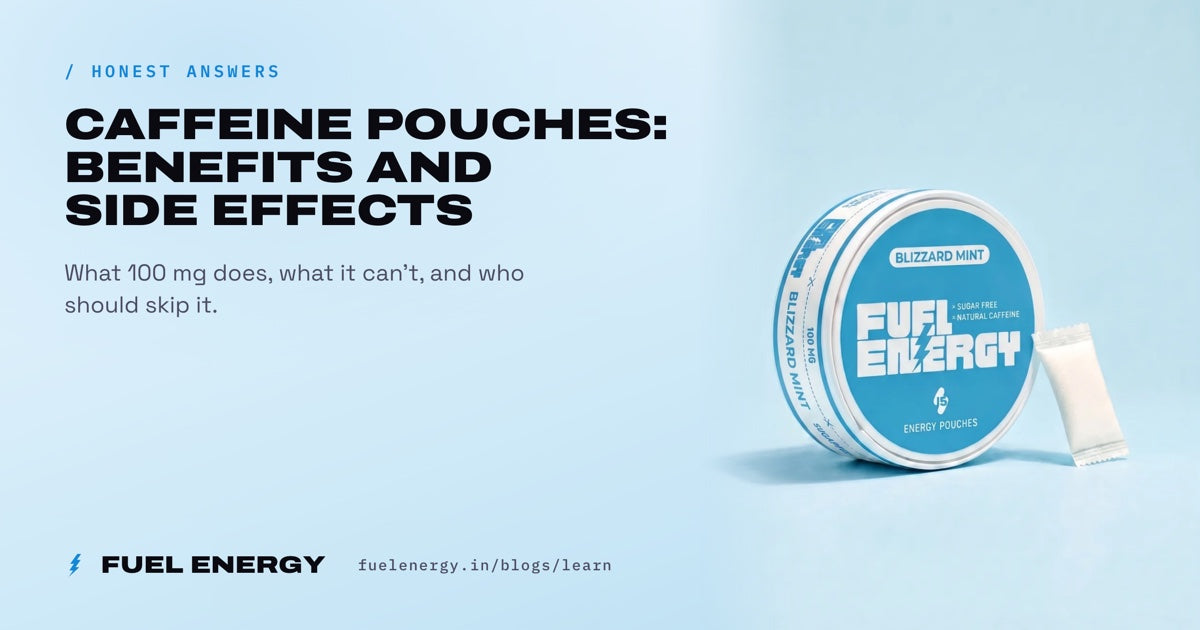
The benefits of a caffeine pouch are the benefits of caffeine, more alertness and attention, in a format you feel in 5–10 minutes with no sugar, no calories and nothing to drink. The side effects are caffeine's too (jitters, a racing heart, poor sleep if you take it late), plus a mild tingle or irritation where the pouch sits.
Here is each one in detail: what the research supports, what it doesn't, and who should skip pouches altogether.
What caffeine itself does
Caffeine is one of the most studied substances in the food supply. It works by blocking adenosine, a chemical that builds up while you're awake and makes you feel sleepy. Europe's food safety authority, EFSA, accepts that around 75 mg of caffeine increases alertness and attention. Sports research finds caffeine makes exercise feel easier and improves endurance; the International Society of Sports Nutrition's 2021 review puts the useful range at 3–6 mg per kg of body weight.
None of that is special to pouches. A coffee does the same once it arrives. What a pouch changes is how the caffeine arrives, and what comes with it.
The benefits that come from the format
- Speed. A good share of the caffeine absorbs through the lining of your mouth, so you feel it in 5–10 minutes instead of the 30–45 a coffee takes. It isn't more caffeine. It's a shorter route.
- A known dose. Every FUEL pouch is 100 mg. A cup of filter coffee can be anything from 80 to 120 mg, and you never know which.
- No sugar, no calories. 0 g sugar and 0 kcal, against roughly 25–30 g of sugar in a regular 250 ml energy drink.
- Nothing to drink. No cup, no can, no bathroom break halfway through a drive or an exam.
- Hands-free. It sits between your lip and gum while you lift, type, game or drive.
- Skips the stomach. There's no acidic coffee or fizzy can sitting in your stomach. Some caffeine is still swallowed with saliva, so it isn't all-or-nothing.
Side effects to know about
| Side effect | Why it happens | What to do |
|---|---|---|
| Tingle or mild sting where it sits | Caffeine and flavour meeting the gum. Normal, and it fades in a couple of minutes | If it still stings after five minutes, take it out |
| Gum or lip irritation | Using the same spot, often, for long stretches | Switch sides, keep each pouch to 30 minutes or less, take days off |
| Jitters, restlessness, anxiety | More caffeine than your body likes, or too much at once | One pouch at a time, and count your coffee and chai too |
| Racing heart or palpitations | High doses, or sensitivity to caffeine | Stop. If it keeps happening, see a doctor |
| Poor sleep | Caffeine's half-life is about five hours | Nothing after mid-afternoon if you sleep around 11pm |
| Queasy stomach | Caffeine on an empty stomach | Try it after food |
| Headaches when you stop | Mild dependence from daily use, the same as with coffee | Cut down over a week rather than all at once |
How much is too much?
For healthy adults, about 400 mg of caffeine a day from all sources is the commonly cited upper limit, and single servings of up to about 200 mg. That makes four pouches a day the absolute ceiling, and fewer once you count your coffee and chai. Most people settle at one or two pouches a day.
If you're new to caffeine pouches, start with one and see how you respond before you go further. Our chart of caffeine in chai, coffee and energy drinks helps you add up a normal day.
Who should skip them
- Anyone under 18.
- Anyone pregnant or breastfeeding.
- People with a heart condition or high blood pressure.
- People with an anxiety disorder or panic attacks.
- Anyone who knows they're sensitive to caffeine.
- Anyone on medication that interacts with caffeine: ask your doctor first.
If any of these apply, talk to a doctor before using any caffeine product, pouch or otherwise.
What the research doesn't know yet
Caffeine is well understood. Caffeine pouches specifically are new, and there is little long-term research on daily pouch use and gum health. Doctors quoted in recent news coverage have raised two concerns: teenagers using pouches, and people stacking pouches on top of energy drinks. Both are good reasons for the 18+ rule and for counting your total.
Our position is simple. Use a pouch the way you'd use a strong coffee, not as a way to take more caffeine than you otherwise would. For the longer version, read are caffeine pouches safe?
Caffeine, not nicotine
Caffeine pouches and nicotine pouches look the same and are not the same thing. FUEL contains no nicotine and no tobacco. Its caffeine comes from green coffee beans, and the full ingredient list is short: natural caffeine, microcrystalline cellulose, xylitol, magnesium stearate, salt, and natural and artificial flavours. How to tell the two kinds apart on a label: caffeine pouch vs nicotine pouch.
Trying one
All three FUEL flavours are 100 mg, sugar-free and 15 pouches to a tin at ₹349. Blizzard Mint is the coldest, and Café Mocha tastes of the coffee it stands in for. See all three.
Quick answers
Do caffeine pouches have side effects?
Yes, the usual caffeine ones (jitters, a faster heartbeat, poor sleep if taken late) plus a mild tingle or gum irritation where the pouch sits. Most come from too much caffeine or too late in the day.
Are caffeine pouches bad for your gums?
Long-term research is thin. The practical risk is irritation from using the same spot often. Switch sides, keep each pouch to 30 minutes or less, and stop if your gum stays sore.
Are caffeine pouches addictive?
Daily caffeine can cause mild dependence: skip it and you may get a headache for a day or two. That's the same as daily coffee, and a different thing from nicotine.
How many caffeine pouches a day is safe?
Most people settle at one or two. Keep your total caffeine from everything under about 400 mg a day.
Is a caffeine pouch better for you than coffee?
It's the same caffeine with a different delivery: faster, no liquid, no sugar if you'd normally sweeten your coffee. If you love your morning cup, keep it. See caffeine pouches vs coffee vs energy drinks.